 PICAXE
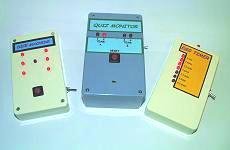
Projects (Part 1) - Egg Timer, Dice Machine, Quiz Game monitor. PICaxe
is a great way to introduce yourself to the world of PIC microcontrollers.
We use modified PIC16F627 devices that can be programmed in BASIC. They
do not need special programming hardware and they can be programmed through
a PC serial link. Using the PICaxe system, you do not need specialist
equipment or knowledge to program the PIC microcontrollers used in these
designs. The flexibility of PIC microcontrollers is considerable and this
series of articles is based around a variant of one of them, using a general
purpose circuit and PCB allowing nine different projects to be realised.
PICAXE
Projects (Part 1) - Egg Timer, Dice Machine, Quiz Game monitor. PICaxe
is a great way to introduce yourself to the world of PIC microcontrollers.
We use modified PIC16F627 devices that can be programmed in BASIC. They
do not need special programming hardware and they can be programmed through
a PC serial link. Using the PICaxe system, you do not need specialist
equipment or knowledge to program the PIC microcontrollers used in these
designs. The flexibility of PIC microcontrollers is considerable and this
series of articles is based around a variant of one of them, using a general
purpose circuit and PCB allowing nine different projects to be realised.
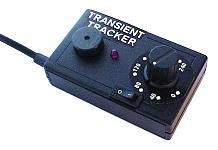
Transient
Checker
- solve a pesky problem caused by "spikes"
or mains transients with our Transient Tracker. Easy to build, this device
can be preset to respond with a beep when spike voltages above a certain
threshold are detected. 230V or 115V a.c.operation. Transformerless PSU
design, for the more experienced constructor.
 In
December 2002 issue (P. 863) we advised that, contrary to information
supplied, Class Y capacitors are intended for use between mains and earth,
and not directly across the mains supply. Class X types are designed for
continuous use across mains and neutral.
In
December 2002 issue (P. 863) we advised that, contrary to information
supplied, Class Y capacitors are intended for use between mains and earth,
and not directly across the mains supply. Class X types are designed for
continuous use across mains and neutral.
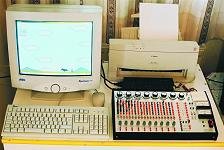 EPE
Hybrid Computer (Part 1) — Real-time computation of complex system
behaviour is greatly simplified by combining analogue and digital processing
techniques -- and that's exactly what we've done in this new Analogue Computer
design. It has features too numerous to list here, and includes:
EPE
Hybrid Computer (Part 1) — Real-time computation of complex system
behaviour is greatly simplified by combining analogue and digital processing
techniques -- and that's exactly what we've done in this new Analogue Computer
design. It has features too numerous to list here, and includes:
- 10 analogue amplifiers
- Each can act as an Adder or Integrator
- Eight co-efficient multipliers
- Three modes of operation, Compute, Hold and Reset
- Automatic or Manual control mode.
- ATOM microcontroller
- Programmable in BASIC
- PCB carries all major components
- PC interface.
Full step-by-step details are provided in our two-part series, along with free programs to demonstrate its effectiveness.
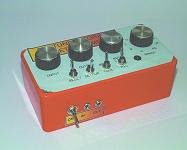 Tuning
Fork & Metronome — thrill everyone by (at long last) getting
your musical instrument properly tuned! This PIC-powered project generates
the initial seven natural notes of any octave. It also compares its own
tone against the frequency of an acoustic or electrical input, via its built
in microphone or line input. Indication via an l.e.d. Also has a built-in
metronome feature with accentuated downbeat.
Tuning
Fork & Metronome — thrill everyone by (at long last) getting
your musical instrument properly tuned! This PIC-powered project generates
the initial seven natural notes of any octave. It also compares its own
tone against the frequency of an acoustic or electrical input, via its built
in microphone or line input. Indication via an l.e.d. Also has a built-in
metronome feature with accentuated downbeat.Also in this issue: New Technology Update: how optical illumination of crystals and nano-tubes reveals their data storage potential; Net Work looks at effective anti-spam email filtering systems; Ingenuity Unlimited offers more readers' own circuits.